
Accounting software for Jordan, built around how accountants here really work
Aspirations is cloud accounting software for companies in Jordan. Beyond journals and reports, it manages your post-dated cheques portfolio, prints receipt and payment vouchers with the amount in Arabic words, withholds income tax on services, and handles 16% sales tax, JoFotara e-invoicing, branches and multi-company consolidation in one Arabic/English ledger.
- Post-dated cheques: in hand, under collection, bounced, endorsed
- Receipt and payment vouchers with amount in words
- Withholding tax with certificates and remittance
- Per-branch statements and group consolidation
Where a basic accounting program stops
Most accounting programs record invoices and payments well. The work that keeps a Jordanian finance team late usually happens outside them.
The challenge
Cheques tracked in a notebook
Post-dated cheques sit in a drawer and in a spreadsheet. Nobody knows at a glance what is due this week, what was deposited, or which customer bounced a cheque last month.
With Aspirations
A cheques portfolio with its own accounts: every receipt, deposit, clearance, bounce, return or endorsement posts its entry and updates the customer statement.
The challenge
Withholding tax worked out by hand
The accountant calculates the deduction on a service bill, pays the net, then rebuilds the list at month end to prepare certificates and the payment to the tax department.
With Aspirations
The deduction is calculated on the payment itself, booked as a liability, and certificates, the period report and the remittance come from the same entries.
The challenge
Branches and companies merged in Excel
Each branch or sister company sends its trial balance and someone combines them, removing intercompany balances by hand.
With Aspirations
Per-branch statements that balance on their own, and a consolidated view across companies that eliminates intercompany sales and balances without posting anything.
A cheques portfolio (حافظة الشيكات) for notes receivable and payable
In Jordan much of business-to-business trade is paid by post-dated cheques. The system treats them as an asset with a life cycle, not as a note on a payment.
- Received cheques — Record a cheque from the invoice payment window or directly on the customer account. The invoice is settled on receipt, and the cheque moves to 'cheques in hand'.
- Deposit, clear, bounce — Deposit to a bank for collection, then mark it cleared or bounced. A bounce reopens the invoices it paid, puts the debt back on the customer and can charge the bank fee to them.
- Endorse or return — Endorse a cheque to a supplier against their bill, return it to the customer, or redeposit a bounced cheque.
- Issued cheques — Cheques you write to suppliers sit in 'post-dated cheques payable' until the bank pays them, so your bank balance shows only what has actually left.
- Due-date alerts — A dashboard list and notifications for cheques due in the coming days, plus a portfolio report by status, bank and due date.
Receipt and payment vouchers, customer statements and credit control
Accountants here work with numbered vouchers, not just payments against invoices. Every voucher posts automatically and can be printed and signed.
- Receipt (RV) and payment (PV) vouchers — From a customer, supplier, employee or any account; by cash, bank transfer, card, cheque or CliQ. Allocate to invoices on posting or later.
- Amount in words — Each voucher prints the amount in Arabic and English words, in dinars and fils, the way a Jordanian voucher is expected to read.
- No deletion after posting — A posted voucher is cancelled with a full reversing entry, so the trail stays in the books. Payment vouchers can require approval.
- Statements from the ledger — Customer and supplier statements are read from the ledger, so they agree with the trial balance and aging, and show cheques not yet collected.
- Credit control — Credit limits and days per customer, an on-hold flag, and exposure that counts uncollected cheques. Choose to warn or block when an invoice goes over the limit.
Sales tax, withholding tax and JoFotara in the same ledger
Tax is calculated on the document and posted with it, so the sales tax return and withholding report agree with the books.
- 16% and your reduced rates — Each company starts with the 16% general rate, zero-rated and exempt, and adds the reduced rates it needs. Choose the rate per product and per line; the return is broken down by rate.
- Withholding tax — Mark suppliers as subject to withholding. The system starts with editable rates (5% resident, 10% non-resident, 7% other) and deducts on payments, vouchers and expenses.
- Certificates and remittance — Certificates per payment or per period in Arabic and English, a period report with CSV, and the remittance to the tax department recorded against the liability.
- Withheld by your customers — When a customer deducts tax from what they pay you, the invoice closes at the gross amount and the deduction is kept as an asset with their certificate number.
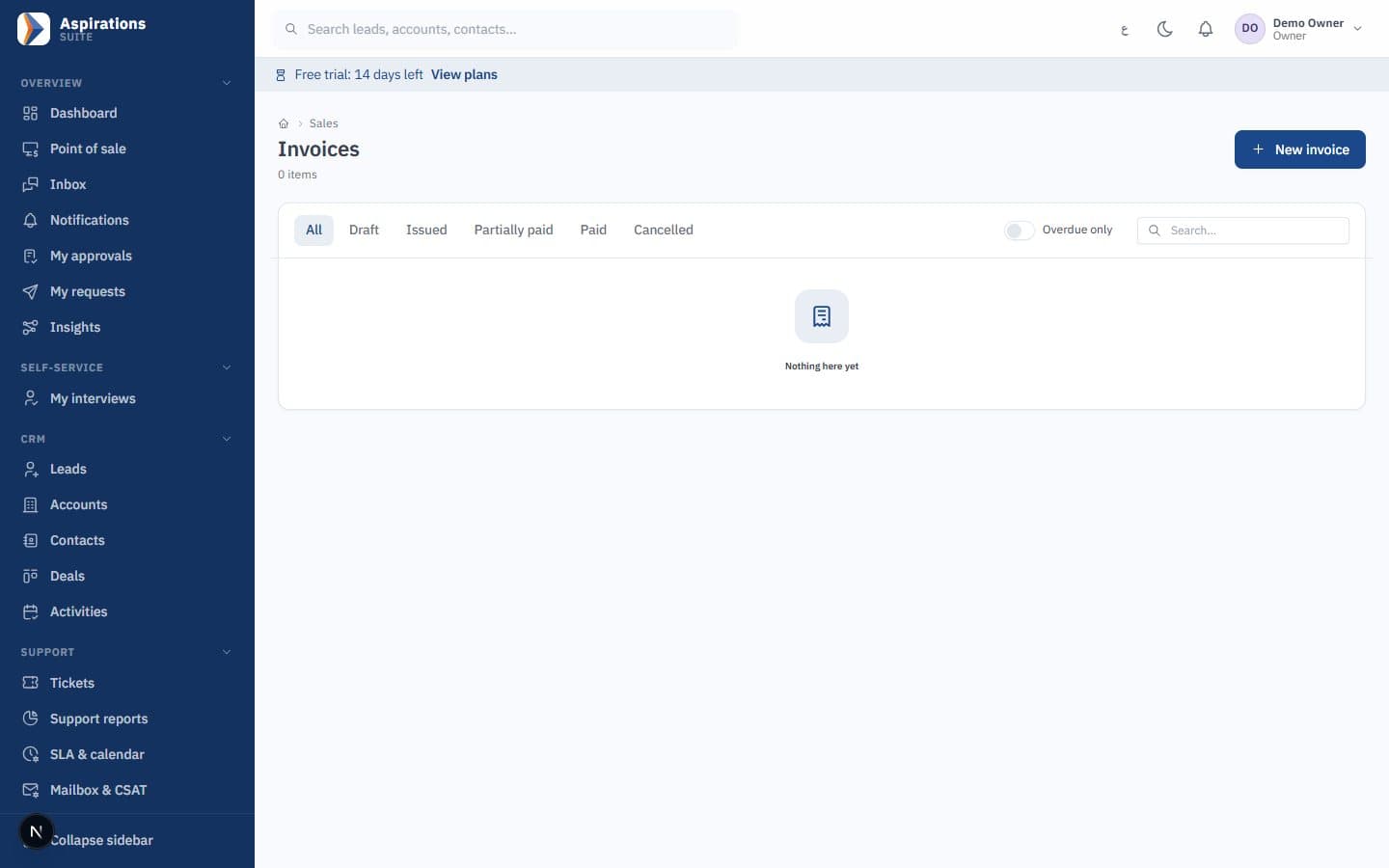
- JoFotara e-invoicing — Integration ready (UBL 2.1); it requires your company's JoFotara credentials. Invoices and credit notes go through one engine with gap-free numbering and the QR code.
Fixed assets, multi-currency and budgets without add-ons
The parts of accounting that usually live in separate sheets are part of the same chart of accounts.
- Fixed assets and depreciation — Straight-line or declining-balance, a monthly depreciation run, a full schedule per asset, and disposal by sale or scrapping with the gain or loss posted.
- Multi-currency and exchange differences — Invoices, bills, vouchers and cheques in foreign currency. The realised difference posts on every settlement, and a month-end revaluation with preview reverses automatically the next day (IAS 21).
- Cash-flow statement — Indirect method (IAS 7) built from your journal lines, with comparison to the previous year or period, a branch filter and a check line that must equal the cash book.
- Cost centres and projects — An optional dimension on invoice, bill, expense and journal lines, and departmental payroll lands on each department's cost centre.
- Budget versus actual — Annual budgets by account with monthly figures, for the whole company or one cost centre, compared with actual results and project profitability.
Branch accounting and multi-company consolidation
Branch is a dimension on every journal line, not a separate chart of accounts, so each branch has its own statements and the company total is always the sum.
- Per-branch statements — Income statement and balance sheet per branch, each balanced on its own, plus the consolidated company view.
- Separate numbering and access — A branch can have its own invoice and credit note sequence, and users can be limited to the branches they work in.
- Group consolidation — Combine several companies you own into a consolidated trial balance, income statement and balance sheet, with intercompany sales and balances eliminated.
- Currencies and minority interests — Members in other currencies are translated at the parent's rates, and non-controlling interests are shown for partly owned companies. Consolidation is calculated, never posted.
Worked example: one post-dated cheque and one withholding deduction
Two everyday cases, with made-up amounts for illustration. Account names follow the default Jordanian chart in the system; your own chart may use different codes.
A customer cheque of 1,160 JOD due in 30 days
| Event | Debit | Credit |
|---|---|---|
| Cheque received against the invoice | Cheques in hand 1,160 | Accounts receivable (customer) 1,160 |
| Deposited at the bank for collection | Cheques under collection 1,160 | Cheques in hand 1,160 |
| Cleared on the due date | Bank 1,160 | Cheques under collection 1,160 |
| Or bounced instead | Accounts receivable (customer) 1,160 | Cheques under collection 1,160 |
The customer statement shows the invoice as paid on the day the cheque arrived. If it bounces, the invoice reopens and the debt is back on the statement, while credit control counts uncollected cheques as part of the customer's exposure until they clear.
A 1,000 JOD service bill from a resident supplier, with 5% withheld
Sales tax is left out to keep the numbers simple. The supplier's balance is settled in full, the cash paid is the net, and the deduction is held as a liability until you remit it.
| Line | Debit (JOD) | Credit (JOD) |
|---|---|---|
| Supplier account | 1,000.000 | |
| Bank | 950.000 | |
| Income tax withheld payable | 50.000 |
The supplier receives a certificate for 50 JOD, and the period report lists it until the remittance is recorded. Which rate applies to which payment is a tax question: confirm it with your tax adviser or the Income and Sales Tax Department. For sales tax itself, see our guide to sales tax in Jordan.
Accounting software or ERP: what changes for the accountant
An accounting program waits for someone to enter what happened. In Aspirations the sales invoice, the delivery note, the POS sale, the supplier bill and the payroll run each post their own entry, so the ledger is a by-product of daily work. That is the difference between an accounting program and an ERP system for Jordan.
- Sales: quotes, sales orders and invoices from the sales and invoicing module post revenue, tax and cost of sales by cost centre and branch.
- Stock: the inventory module keeps the inventory account equal to the value of stock, at average cost or FIFO, with landed costs added to the items they belong to.
- Production: manufacturing posts work in progress, applied overhead and production variances.
- Payroll: the approved payroll with social security and income tax posts salaries and employer contributions by department and branch.
The everyday basics are there too
A chart of accounts seeded for Jordan and fully editable, manual and recurring journals that reject unbalanced entries, locked closed periods, bank reconciliation with suggested matches, and the trial balance, general ledger, income statement, balance sheet, sales tax return and aging reports.
Related pages
Accounting is the centre of the ERP. These pages cover the parts that feed it.
Related guides
- Jordan sales tax: the 16% rate, zero-rated and exempt supplies
- Best accounting software in Jordan: an honest comparison
- Accounting entries for post-dated cheques (with JOD examples)
- Withholding tax in Jordan: rates, who withholds and the accounting entries
- Jordan e-invoicing: a step-by-step JoFotara guide
- Payroll journal entries: a worked example for Jordan
- All guides
Questions about accounting software in Jordan
What accountants and finance managers ask before they switch.
What is the best accounting software in Jordan?
Does the accounting software manage post-dated cheques?
Does it support more than one currency?
Can approvals be required before paying or posting?
Does it calculate withholding tax and issue certificates?
Is it compatible with JoFotara?
Is it suitable for accounting offices?
How much does it cost, and is there a trial?
See your own month-end in Aspirations
Book a demo and we will walk through cheques, vouchers, withholding tax and branch statements with an example from your company.
Request an accounting demo
Tell us about your company, branches and current accounting program, and we will schedule a live walkthrough.